There are several inlets through the boat that include valves for opening and closing such inlets. It is recommended to keep these inlets closed if the boat is out of use for a long time, and to open them again when the boat is used again. If the boat is lifted out from water or in rainy conditions, inlets should be kept open.
Always check that all hatches are securely closed before and after using the boat.
We recommend that you keep the windows, doors, deck hatches, roof hatches, vents and interior doors closed while driving. In stormy weather, always keep them securely closed to minimize the risk of water getting into the boat and to avoid any personal injuries.
In certain conditions and speeds, it is possible that water is sprayed inside through canopies, hatches or other openings, due to negative pressure or other effects. Risk for this can be minimized by closing the canopies, hatches or other openings.
All doors and hatches must be kept shut when under way.
The figure shows the hatches and seacocks that must be kept closed when the boat is left unmanned. Keep hatches closed also while underway.
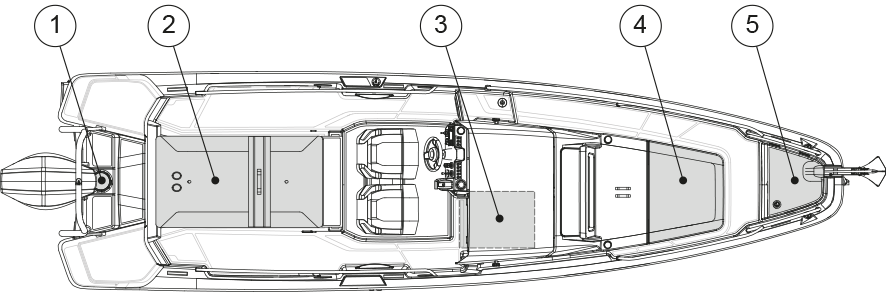
- (1)
-
Inspection hatch in the motor bracket
- (2)
-
Floor hatch or multistorage roof hatch
- (3)
-
Front cabin door
- (4)
-
Front cabin roof hatch
- (5)
-
Front storage box
The location and number of these components depend on the level of the equipment on the boat.
The location and number of these components depend on the level of the equipment on the boat.
The figure shows locations of through hull fittings installed to the boat.
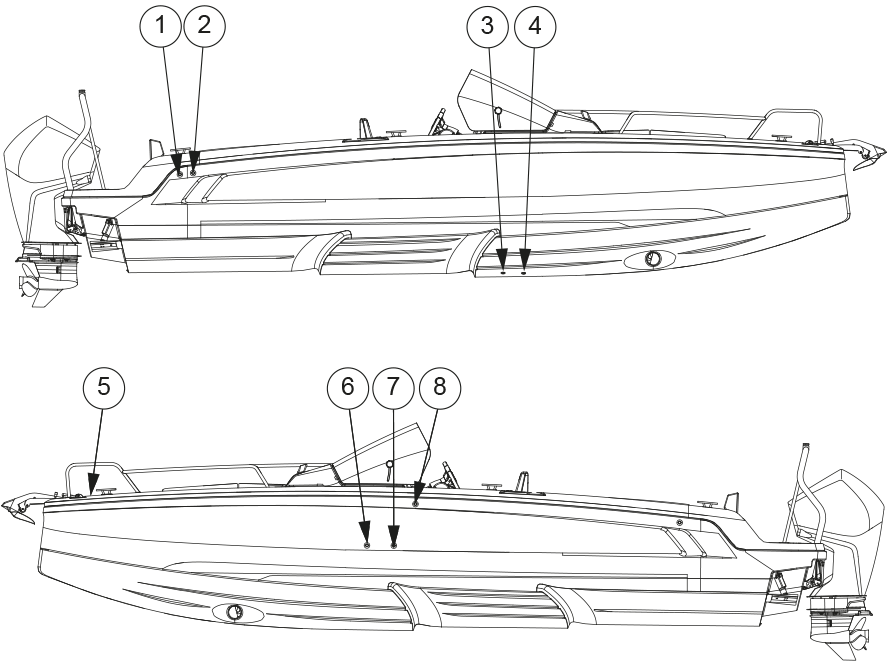
- (1)
-
Manual bilge pump outlet
- (2)
-
Automatic bilge pump outlet
- (3)
-
Septic discharge
- (4)
-
Transducer
- (5)
-
Sink outlet
- (6)
-
Sink outlet
- (7)
-
Septic tank ventilation
- (8)
-
Fresh water tank ventilation